Much of Tennessee sits on soluble carbonate bedrock — the Ordovician-age limestone of the Nashville Basin, the karst terrain bordering the Highland Rim and Cumberland Plateau, and the Valley and Ridge province of East Tennessee. As groundwater slowly dissolves this limestone, it creates underground voids and unpredictable subsurface conditions that can lead to sinkholes and differential foundation settlement, often with no visible surface warning until a structure is already showing signs of movement. TDOT project teams and Tennessee commercial developers alike encounter foundation movement traced to confirmed or suspected dissolution activity beneath the state's carbonate bedrock, and addressing it properly starts with subsurface investigation, not surface-level patching.
It's a recurring example of the Foundation Settlement Issues GSI addresses for agencies and property owners across karst-affected regions nationwide.
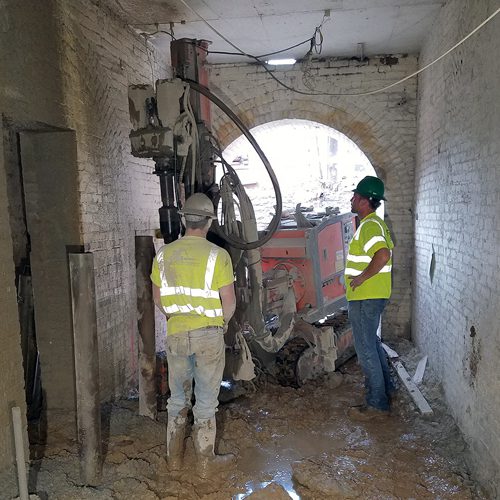
Micropiles are small-diameter, high-capacity piles — typically 5 to 12 inches across — that are drilled and grouted in place, extending past Tennessee foundation soils that geophysical investigation has flagged as dissolution-prone and transferring structural loads into verified competent bedrock below. Because installation produces minimal vibration and noise and can be carried out in tight or low-clearance spaces, micropiles are well suited to underpinning occupied buildings, bridge substructures, and older structures without extensive excavation. This is one application of GSI's broader foundation bearing micropiles expertise.
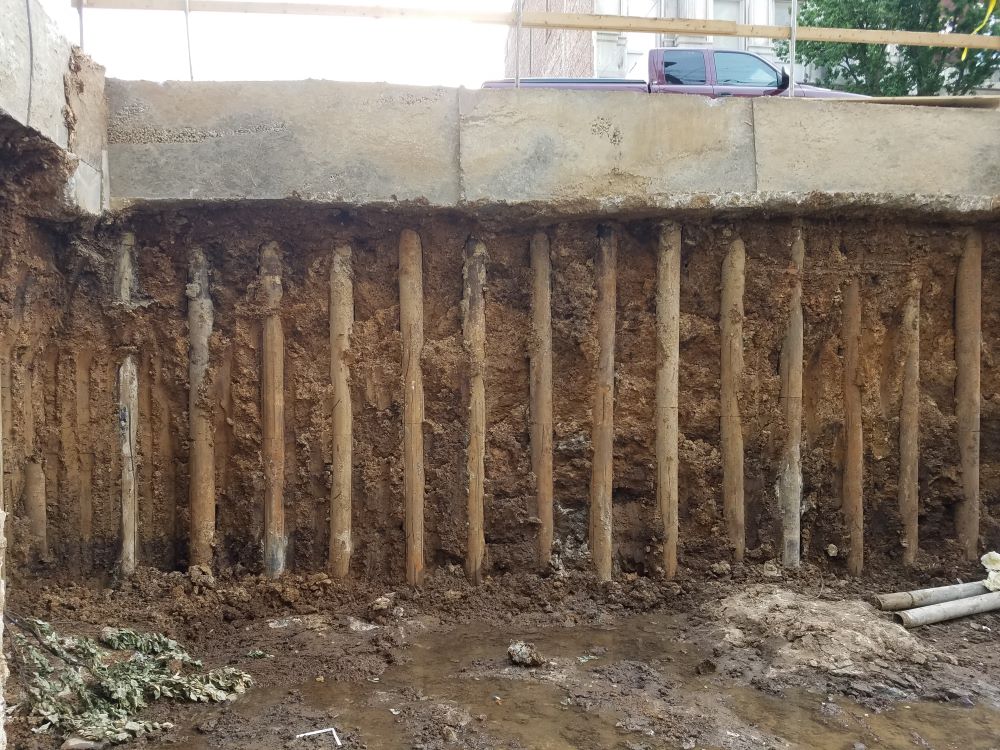
Helical piers are installed through the zone affected by dissolution and into competent, non-expansive bearing material below, giving Tennessee structures confirmed, load-tested support where limestone dissolution has introduced uncertainty about long-term ground stability. Void forms built into the installation accommodate any continued ground movement around the structure. This approach draws on GSI's foundation footings for sinking structures experience.
Once piers or piles confirm stable, verified bearing support, hydraulic jacks are used to relevel the structure back toward its original design grade — addressing the differential settlement itself rather than only halting further movement. This work is informed by GSI's ground improvement solutions experience.
GSI's engineers' experience also shapes how these Tennessee projects are scoped from the first site visit, with prompt assessments and fast proposal turnaround so project teams can move from evaluation to design without delay.
Engineered for Tennessee's conditions. GSI's Tennessee underpinning approach applies the same karst-verification standard used across the broader Appalachian carbonate belt Tennessee shares with Kentucky, Alabama, and Virginia. Trusted by commercial properties and asset owners statewide.
Design/build delivery. Design and build responsibility sit with one team, closing the gap between engineering intent and field execution.
TDOT specification compliance. Engineering documentation and installation practices meet DOT standards from initial submittal through final inspection.
Rapid response when conditions demand it. Beyond planned underpinning work, GSI's emergency response team is available around the clock for sudden sinkhole activity or structural distress affecting roadways, bridges, and commercial facilities.
GSI's engineers deliver a warrantied, design/build foundation solution built for Tennessee's karst conditions.