Launched nails install at up to roughly 250 twenty-foot nails per day, so most walls complete in days rather than the weeks a conventional drilled system needs in saturated ground.

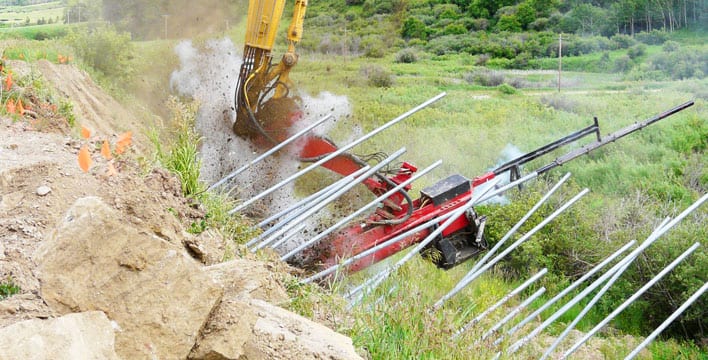
Soil nailing turns the ground itself into the retaining structure instead of building a separate wall to hold a slope or cut face back. Crews install a grid of near-horizontal grouted steel bars into the face from the top down as excavation proceeds, then finish the surface with shotcrete.
GSI installs soil nails across Harris County using our patented Soil Nail Launcher™, which fires a launched nail into the slope at up to 250 miles per hour instead of drilling a conventional borehole. That capability matters along the county's bayous and in saturated coastal clay generally, where a conventional open borehole can collapse before a drilled nail is even placed. GSI's Harris County soil nail projects typically involve:
Launched nails install at up to roughly 250 twenty-foot nails per day, so most walls complete in days rather than the weeks a conventional drilled system needs in saturated ground.
A soil nail wall typically costs 25 to 50 percent less than an equivalent-height soldier pile wall and becomes a permanent structure. We provide a fixed-cost proposal after reviewing site and groundwater conditions.
Yes. Every design is stamped by a licensed Professional Engineer and meets IBC and Texas Building Code requirements for permanent earth retention.
Yes. GSI offers 24/7 emergency response, and the Soil Nail Launcher is well suited to saturated, actively eroding ground since it doesn't require a stable open borehole.
A conventional drilled nail relies on an open borehole that can collapse in wet, high-plasticity clay before the nail is placed. A launched SuperNail™ is fired in a single shot and compacts the surrounding soil rather than depending on a hole that stays open.
We evaluate soil saturation, erosion history, and existing movement before finalizing nail length and spacing, since bayou banks vary significantly in how far erosion has already progressed.
The launched installation method is less sensitive to groundwater than a conventional open borehole, though our engineers account for water table depth in the design.
Yes, and it's a common application for slope stabilization in drainage and flood-control easements, subject to coordination with the applicable easement holder.
An unreinforced slope along a Harris County bayou can give way with little warning during a heavy rain event. Call (855) 599-5217 to get a soil nailing assessment from a licensed engineer.