

Nevada's landslide risk is concentrated in the Basin and Range province's steep, faulted mountain fronts, where US-50 and I-80 corridors cross alluvial fan and colluvial slopes destabilized by the state's characteristic flash-flood monsoon events rather than the chronic rainfall patterns that drive slope failure elsewhere — a desert-specific triggering mechanism NDOT's maintenance history reflects.
GSI sees this alongside other Steep Slope Stability Issues work across the state's infrastructure network.
GSI anchors Nevada soil nail walls into the more competent bedrock beneath the state's loose alluvial fan deposits, since the fan material itself rarely provides adequate bearing for reinforcement on its own. GSI's soil nailing experience informs this approach.
Because Nevada's failures are flash-triggered by short, intense monsoon cells, drainage systems are sized for rapid infiltration events rather than the steady seasonal seepage drainage design in wetter states typically assumes. This draws directly on GSI's Soil Nail Launcher™ work.
Loose Nevada alluvial fan material collapses around conventional boreholes readily during flash-triggered saturation — the Soil Nail Launcher™ installs before the hole has time to close. GSI's horizontal drains capability supports this step.
Where relevant, landslide emergency response is factored into the Nevada project plan from day one.
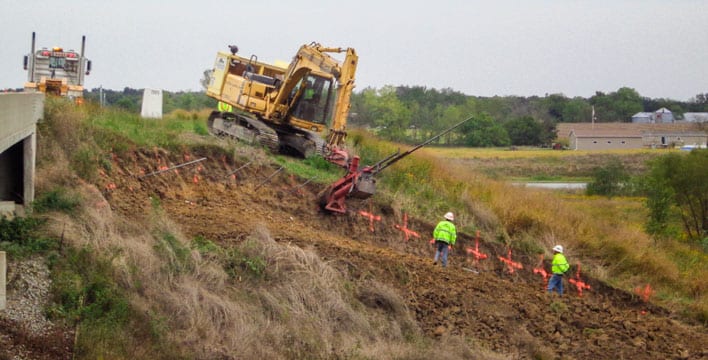
Engineered for Nevada's conditions. GSI designs Nevada slope repairs around flash-triggered monsoon saturation on alluvial fan terrain — a distinct desert failure mode from the chronic-rainfall triggers assumed in wetter states. This is reinforced by GSI's work in general contractors and asset owners.
Design/build delivery. Engineering and field crews work as one team — eliminating coordination gaps between engineering and construction.
NDOT specification compliance. Documentation and installation methods align with DOT standards from the first review cycle.
GSI's engineers are ready to assess landslide repair conditions at your Nevada site.