Alaska's retaining walls face a combination of ground conditions with no direct equivalent elsewhere in this program. Ice-rich permafrost thaw causes the ground to lose volume unevenly as ground ice melts, driving the kind of differential settlement that cracks walls and shifts foundations along AKDOT&PF corridors like the Seward and Parks Highways, and because disturbing or loading permafrost tends to accelerate its thaw, that movement often continues evolving after a repair is complete.
Statewide, permafrost thaw-related infrastructure damage is projected to cost tens of billions of dollars by mid-century under current climate trends. Layered on top of that is Alaska's seismic exposure: the state is the most seismically active in the country, averaging a magnitude 8-or-greater earthquake roughly every 13 years, including the magnitude 9.2 Great Alaskan Earthquake of 1964, the second-largest ever instrumentally recorded. AKDOT&PF walls have to perform through both this ongoing ground movement and some of the strongest seismic design requirements in the country.
GSI treats this as one of several Foundation Settlement Issues issues the state's infrastructure owners regularly face.
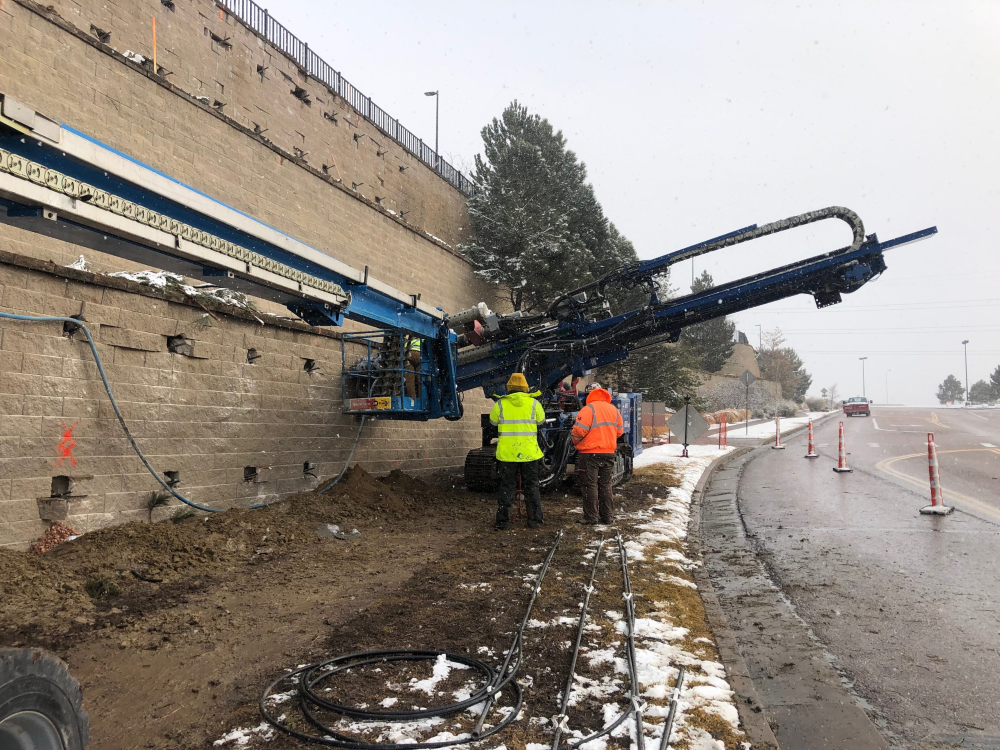
Soil nailing for Alaska's permafrost-adjacent walls builds in adjustment capacity that most soil nail patterns don't require elsewhere, accounting for the possibility that the ground beneath a wall keeps settling or shifting after installation as underlying permafrost continues to thaw. This draws directly on GSI's soil nailing work.
Helical tieback and buttress systems for Alaska walls use hardware rated for the state's extreme temperature range. Standard steel becomes brittle below its ductile-to-brittle transition temperature, so components exposed to Alaska winters require low-temperature-rated alloys formulated to hold their toughness in subzero cold as well as summer thaw conditions. GSI's retaining wall instability solutions capability supports this step.
Drainage correction on Alaska walls manages both standard groundwater infiltration and the meltwater permafrost thaw actively generates as ice-rich ground loses volume, a water source distinct from ordinary site drainage. This is one application of GSI's broader excavation shoring expertise.
GSI often considers engineers' input alongside this work when scoping Alaska projects, with prompt site assessments and fast proposal turnaround so project teams can move from evaluation to design without delay.
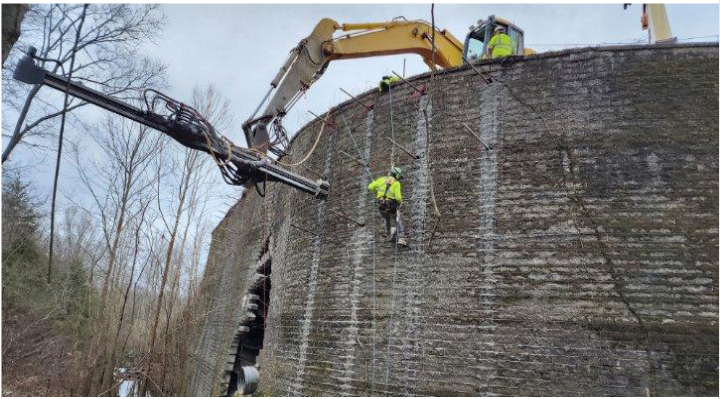
Engineered for Alaska's conditions. GSI's Alaska wall repairs account for continuing permafrost-related ground movement after installation, layered onto some of the highest seismic exposure in the country. GSI's general contractors and commercial properties experience backs this approach.
Design/build delivery. Engineering and construction remain under one team, cutting out the delays that separate design from installation.
AKDOT&PF specification compliance. Documentation and construction methods meet state DOT standards from the earliest project submittal.
Rapid response when conditions demand it. Beyond planned repair work, GSI's emergency response team is available around the clock for sudden wall movement or failure affecting roadways and adjacent infrastructure.
GSI's engineers deliver a warrantied, design/build retaining wall solution engineered for Alaska's permafrost thaw and seismic conditions.