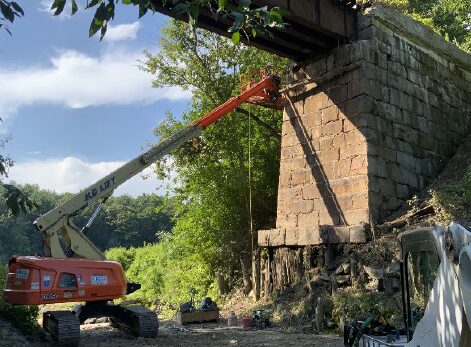



A comprehensive infrastructure inspection in 2022 identified three 19th-century stone railroad bridges in New England that required historic bridge rehabilitation to safely accommodate increased rail traffic and higher train speeds. The structures—located in Augusta, Maine; Westford, Massachusetts; and Lancaster, Massachusetts—each presented a different combination of structural challenges, including foundation scour, deteriorated bridge seats, degraded mortar joints, and internal voids within stacked stone piers.
Because of the bridges’ age and historic masonry construction, the rehabilitation effort required carefully engineered solutions that would strengthen the structures while preserving their historic stone architecture. GeoStabilization developed customized rehabilitation strategies for each bridge, combining modern structural stabilization techniques with traditional masonry restoration methods.
At the Augusta bridge site, significant scour had undermined the north abutment, exposing and degrading the timber piles that support the stacked stone foundation. As part of the historic bridge rehabilitation effort, GeoStabilization installed sheet pile encapsulation and structural backfill grouting to stabilize the abutment and protect it from continued erosion.
Structural concrete was used to fill voids within the timber pile system, restoring strength to the foundation and reinforcing the surrounding soil mass. After the foundation stabilization was completed, crews performed precision tuckpointing and mortar sealing across the exposed stone joints, restoring the masonry while preventing water infiltration that could accelerate future deterioration.
At the Westford bridge, internal voids had formed within a stacked stone pier, weakening the structure. GeoStabilization implemented precision void-fill grouting, injecting hydraulic cement and high-strength grout with compressive strengths of approximately 8,000 psi. This process reinforced the internal structure of the pier while preserving the exterior historic masonry.
Once the void fill grouting was complete, crews restored the exterior mortar joints through detailed tuckpointing, an important step in historic bridge rehabilitation that preserves the appearance and durability of stone masonry structures.
At the Lancaster bridge, deterioration of the bridge seat required structural reinforcement. GeoStabilization installed mesh-reinforced shotcrete encapsulation using 4,000 psi shotcrete, reinforced with dowels and steel through-rods to improve rigidity and load transfer. Existing sheet piles at the site were incorporated as both formwork during installation and long-term scour protection for the foundation.
Through a combination of scour protection, structural grouting, shotcrete reinforcement, and traditional masonry restoration, GeoStabilization successfully completed the historic bridge rehabilitation of three important stone railroad bridges in New England.
The project restored structural integrity while preserving the historic character of the masonry bridges, allowing them to safely support modern rail operations for decades to come. This work demonstrates GeoStabilization’s expertise in historic bridge rehabilitation, stone masonry stabilization, and infrastructure restoration, where engineering performance and cultural preservation must work together.