Geohazard Mitigation Services in Virginia

Geohazard Mitigation Services in Virginia

Expert geohazard mitigation Virginia solutions including slope stabilization, rockfall mitigation, landslide remediation, and 24/7 emergency response across the state, engineered for Blue Ridge Mountain terrain, Appalachian geology, Piedmont soils, and Virginia’s variable rainfall and freeze-thaw climate conditions.

Get Your Free Assessment
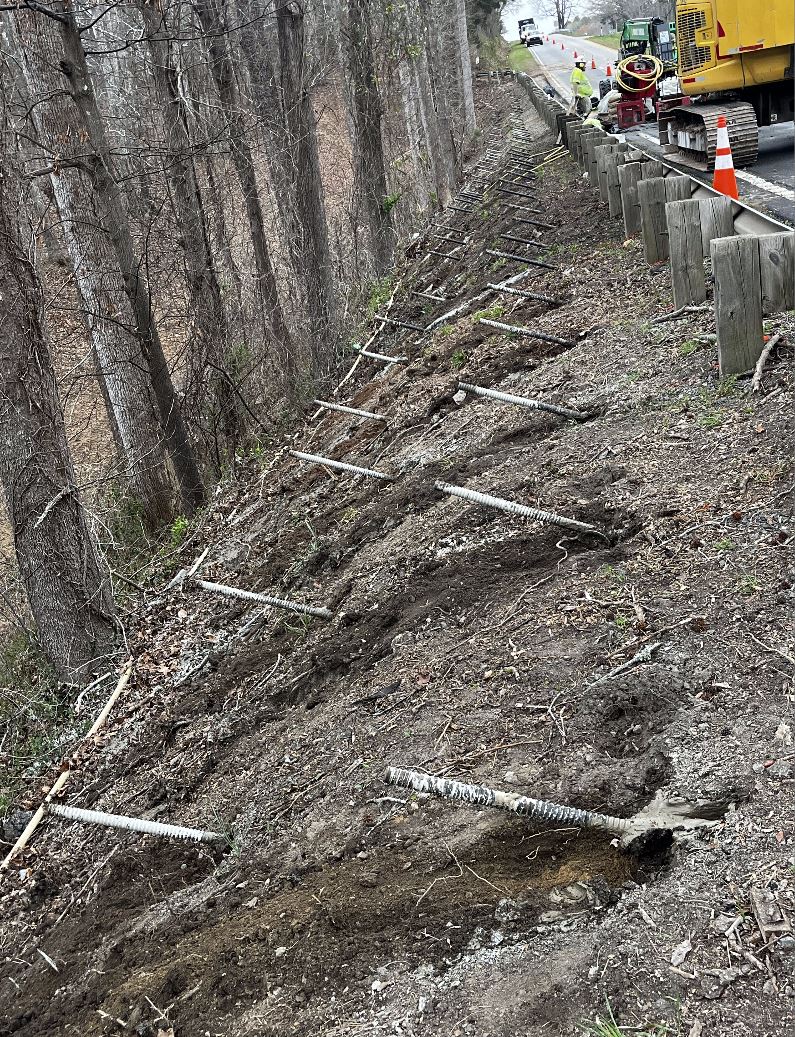
Soil nails installed on forested highway slope, US-58 eastbound

GeoStabilization International's Virginia Expertise

Effective geohazard mitigation Virginia projects require understanding the state’s complex geological regions. The Blue Ridge Mountains and Appalachian Highlands contain steep slopes with fractured metamorphic and sedimentary rock formations that are susceptible to rockfall and landslides, particularly along major transportation corridors such as I-81 and I-64. In the Shenandoah Valley, layered limestone and shale formations can influence slope stability and groundwater movement, creating localized geotechnical challenges for infrastructure and development.

Across Virginia’s Piedmont region, deeply weathered soils and residual clays may contribute to embankment instability during extended rainfall events. Seasonal freeze-thaw cycles in the mountainous western part of the state further accelerate rock fracturing and long-term slope degradation.

GeoStabilization International delivers design-build solutions tailored to Virginia’s mountain highways, river valleys, and growing infrastructure corridors, integrating engineering and construction to address site-specific geological and environmental conditions.

View Our Solutions
Active Landslide or Rockfall in Virginia?

Stabilize the slope before conditions worsen.

Virginia's Geohazard Challenges

Virginia’s diverse terrain, ranging from the Appalachian Mountains to the rolling Piedmont and coastal regions, creates a wide range of geotechnical hazards. Steep slopes along the Blue Ridge and Allegheny Mountains are prone to rockfall and landslides, particularly where road construction exposes fractured bedrock. Intense rainfall events, hurricanes moving inland from the Atlantic, and seasonal freeze-thaw cycles can saturate soils and weaken slope stability. Effective geohazard mitigation Virginia strategies must account for variable soil conditions, complex bedrock structures, groundwater flow, and infrastructure loading to ensure long-term slope performance.

Our Core Services:

  • Slope Stabilization: Soil nailing, ground anchors, and retaining wall systems
  • Rockfall Mitigation: Rock bolting, scaling, draped mesh, and attenuator barriers
  • Landslide Remediation: Complete assessment-through-construction stabilization services
  • Foundation Solutions: Micropiles, helical piers, and underpinning systems for unstable soils
  • Emergency Response: 24/7 availability for critical geohazard events and slope failures
  • Design-Build Delivery: Integrated engineering and construction from assessment through implementation

Our Project Process

From initial assessment through long-term warranty support, we follow proven steps to ensure successful stabilization.

Step 1

Site Assessment

Comprehensive geotechnical investigation and hazard evaluation.

Step 2

Engineering Design

Custom design solutions tailored to site conditions.

Step 3

Rapid Execution

Deploy specialized equipment and experienced crews.

Step 4

Warranty Support

Performance guarantee and ongoing monitoring.

Need Help?

Call anytime

Need Help?

Call anytime

Virginia Geohazard Mitigation

Frequently Asked Questions

Landslides in Virginia are commonly associated with steep Appalachian slopes, weathered bedrock, and prolonged rainfall. Mountain corridors such as those along I-81 and I-64 may experience slope movement when heavy precipitation saturates soils and reduces shear strength. Stabilization approaches typically include slope reinforcement systems, drainage control, and engineered retaining structures designed for site-specific geology and hydrology.

Yes. Virginia’s varied geological regions create multiple potential hazards, including rockfall in the Blue Ridge Mountains, landslides in steep Appalachian terrain, and embankment instability in Piedmont soils. Geohazard mitigation Virginia planning evaluates slope geometry, subsurface conditions, groundwater movement, and infrastructure exposure to develop long-term stabilization strategies.

Yes. Emergency stabilization services are available statewide. When landslides, rockfall, or storm-related slope failures threaten infrastructure or property, crews can mobilize to assess conditions and implement immediate stabilization measures.

Design-build delivery integrates engineering and construction within a single coordinated process. This approach improves constructability, streamlines communication, and allows stabilization systems to be implemented more efficiently while maintaining technical oversight.

The evaluation process begins with a detailed site assessment that considers slope geometry, soil and rock stratigraphy, groundwater conditions, drainage patterns, and infrastructure constraints. Engineering analyses are then performed to design stabilization systems appropriate for Virginia’s terrain and environmental conditions.

Submit the form to request a site evaluation. Our team will review conditions, identify instability risks, and recommend stabilization solutions tailored to your property or infrastructure needs.

Ready to Stabilize Your Virginia Property?

Landslides, rockfall hazards, and slope instability can escalate quickly across Virginia’s Appalachian Mountains, river valleys, and transportation corridors. Request a geohazard mitigation Virginia assessment to receive a site-specific stabilization plan designed for the state’s complex geology and long-term infrastructure performance.

855.579.0536

    How Can We Help?

    • Personal Info
    • Contact Info
    • Project Info
    ***Fees May Apply For Residential Site Visits***

    How Can We Help?

    • Personal Info
    • Contact Info
    • Project Info

    How Can We Help?

    • Personal Info
    • Contact Info
    • Project Info

    By using this website, you acknowledge and agree to our Privacy Policy. This site is protected by reCAPTCHA, and the Google Privacy Policy and Terms of Service apply.