The July 2023 floods made clear what Vermont's geologists had long documented: the state's steep, saturated slopes are vulnerable to rapid failure when intense rainfall saturates already wet ground. At peak impact, nearly 100 state and US highway routes were closed. A landslide in Ripton destroyed one home and damaged 12 others. US-4 near Killington was closed by a slope failure. The scale of debris flows and landslides spilling onto Vermont's roadways was, by VTrans's own assessment, a new phenomenon at that magnitude — and it prompted VTrans to engage outside expertise and launch a new landslide hazard identification program with the University of Vermont.
Vermont's slope failure conditions are driven by a consistent set of factors: steep Green Mountain terrain, metamorphic soils that lose strength rapidly when saturated, glacially deposited materials on slopes that were never fully stable, and the freeze-thaw cycling that progressively weakens residual soils each winter. Vermont's state geologist described the July 2023 events directly: when 3 to 5 inches of precipitation falls on already saturated ground, slopes that have been stable for decades can fail within hours. Emergency patching — regrading the slide mass, repaving the road, reopening the corridor — treats the surface without addressing the failure mechanism. The same slope fails again the next wet season. VTrans has engaged outside geotechnical expertise to move beyond that cycle.
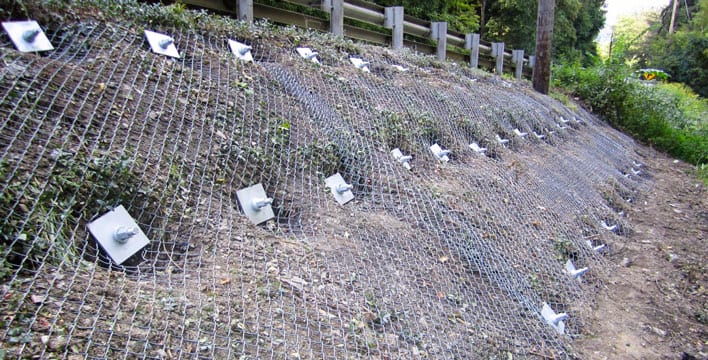
Soil nailing reinforces failed slopes from within — driving steel reinforcement through the slide mass into stable material below the failure surface. The nailed zone resists the driving forces that caused movement in the first place. On Vermont's saturated, actively moving slopes, GeoStabilization International installs soil nails using both conventional drilling and the patented Soil Nail Launcher™, which fires SuperNails™ into saturated ground without excavation — reaching and reinforcing material that conventional drilling cannot reliably access.
Vermont's highway corridors see many shallow translational failures — where weathered residual soils slide along a relatively shallow failure surface after rainfall saturates them. Driven steel pins provide rapid, cost-effective reinforcement for these conditions without the full construction footprint of a soil nail wall. Combined with surface drainage improvements, slope pins can arrest active shallow slides within days of mobilization.
Water triggered every major slope failure in Vermont's July 2023 event — and water triggers the recurring seasonal failures on Vermont's highway network. GeoStabilization International designs drainage systems that reduce pore water pressure within the slope mass. Drainage combined with reinforcement provides the layered defense that prevents future reactivation through Vermont's wet springs and intense summer rainfall events.
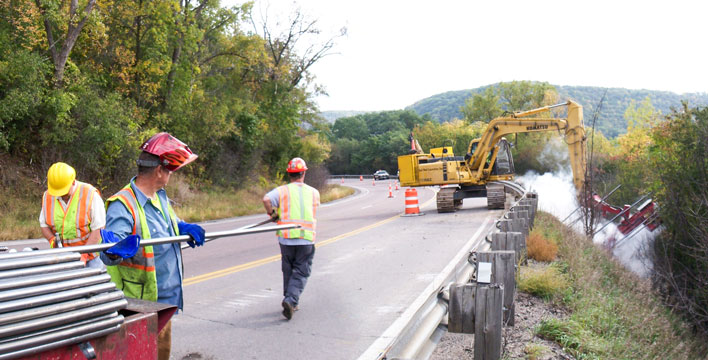
Soil Nail Launcher™ for difficult soils. When saturated Vermont soils collapse conventional boreholes, our Launcher installs reinforcement on the first attempt — no failed drilling, no wasted mobilization.
Deep failure plane targeting. We engineer repairs that reach the actual failure surface, not surface patches that reactivate the following wet season.
Integrated drainage design. Every slope repair includes drainage engineering because water is the trigger for virtually every Vermont landslide.
VTrans-ready documentation. Engineering designs, construction records, and as-built drawings meeting state specifications from first submittal through closeout.
Vermont's July 2023 floods closed nearly 100 highways and pushed VTrans beyond what routine maintenance could handle — and those conditions haven't changed. Request a slope assessment to get started.