
South Dakota's expansive soil problem has a specific geological source: Cretaceous Pierre Shale. This formation underlies much of central and west-central South Dakota, and the smectitic clay minerals it weathers into are among the most expansive in the country. SDDOT-commissioned research identified multiple active fault zones where Pierre Shale deposits intersect highway embankments and drainage features, producing localized heaves that recur with every moisture fluctuation and require repeated maintenance interventions.
The problem extends beyond the capital. Across South Dakota's central highway network — including US-14, US-83, and SD-34 corridors — Cretaceous shale subgrades generate the same swell-shrink cycle with every moisture change. Seasonal snowmelt and spring rainfall push clay minerals outward, summer desiccation pulls them back, and each cycle compounds the deterioration from the one before. Traditional maintenance — patching, mudjacking, seasonal grade corrections — treats surface damage while the clay beneath continues cycling. The annual cost accumulates without addressing the underlying mechanism.
Where structures have been displaced by swell cycles — bridge approach slabs, retaining walls, building foundations — the most reliable long-term solution transfers foundation loads entirely through the active zone to stable bearing strata below the Pierre Shale's zone of seasonal moisture influence. Helical piers accomplish this by screwing through the expansive clay layer to refusal in non-expansive material below, anchoring the structure independent of surface soil movement.
For heavier structural loads or sites where access constraints limit helical pier installation, GeoStabilization International's micropiles provide high-capacity deep foundation support through South Dakota's expansive subgrades. Small-diameter, drilled and grouted micropiles transfer structural loads to stable soil or rock below the active swell zone with minimal vibration and surface disturbance — making them well-suited for repairs to existing bridge abutments, retaining systems, and infrastructure on active corridors.
Where road subgrades have lost density and bearing capacity through repeated swell cycles, compaction grouting restores ground support without full excavation and reconstruction. High-pressure injection of stiff, low-mobility grout displaces and densifies loose or raveled subgrade material, improving bearing capacity and reducing the differential movement that accelerates pavement deterioration along Pierre Shale corridors.
Every expansive soil event in South Dakota is triggered by a moisture change. Spring snowmelt, summer thunderstorms, and irrigation runoff all drive subgrade saturation — and South Dakota's clay shales absorb that moisture rapidly. GeoStabilization International designs drainage systems that intercept surface water and reduce subgrade moisture fluctuation, reducing swell cycle amplitude across the full project corridor.
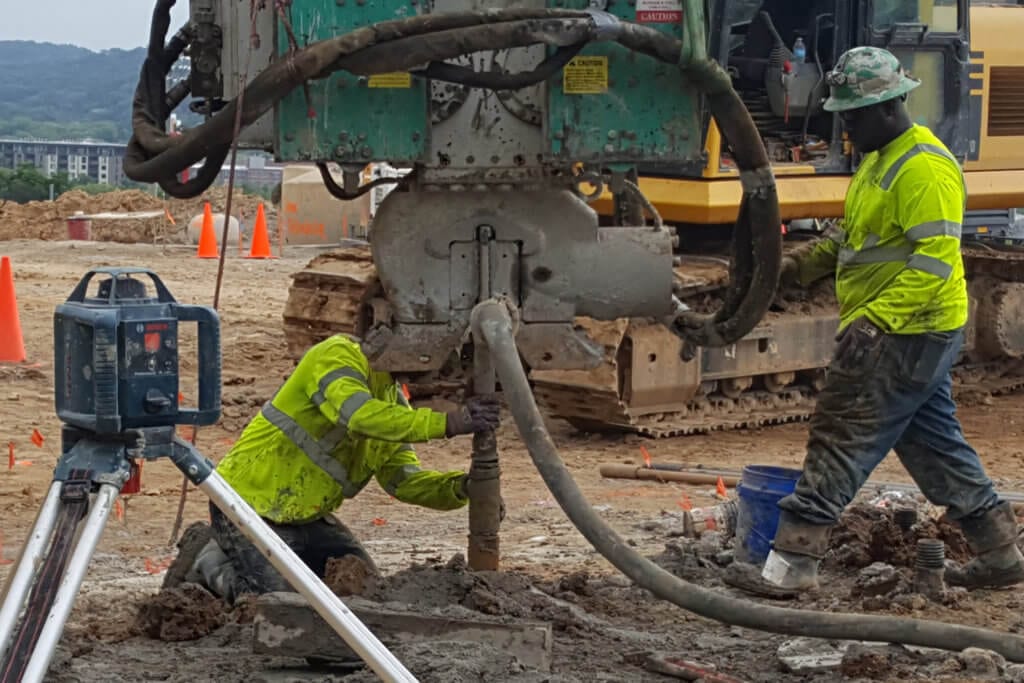
South Dakota's Pierre Shale fault gouge locations demand more than repeated surface maintenance. GeoStabilization International's approach transfers structural loads below the swell zone entirely — removing the active soil from the structural equation rather than managing its surface expression.
Pierre Shale fault gouges and expansive subgrades across South Dakota's central highway corridors will keep heaving with every wet season until structures are anchored below the active zone. GeoStabilization International's engineers are ready to assess your site, design a solution built for South Dakota's geology, and deliver it under a performance warranty. Request a soil assessment to get started.