
Indiana's Mitchell Plain is one of the most extensively documented karst engineering challenges in the Midwest. The plateau's Mississippian-age limestones — including the Salem, St. Louis, Ste. Genevieve, and Paoli formations of the Sanders and Blue River Groups — are exceptionally pure carbonate, roughly 500 feet thick in places, and highly susceptible to dissolution by the weak carbonic acid produced as rainwater percolates through soil. The Mitchell Plain was largely spared by glaciation, which means these limestone formations are exposed or thinly covered — and have been dissolving continuously for hundreds of thousands of years.
The result is a subsurface honeycombed with fractures, solution channels, and caves that INDOT's own engineering guidance identifies as the primary challenge for highway route selection, design, and construction across Lawrence, Orange, and Washington counties. When groundwater flow accelerates during wet periods, the dissolution rate increases, soil particles migrate into growing rock cavities, voids expand upward through the overburden, and infrastructure above settles — gradually at first, then suddenly.
That progression — from invisible dissolution to pavement cracking to approach slab misalignment to collapse — is what makes karst subsidence on Indiana's US-50 corridor and county highway network so difficult to manage reactively. By the time surface damage is obvious, the subsurface condition has already been developing for months.
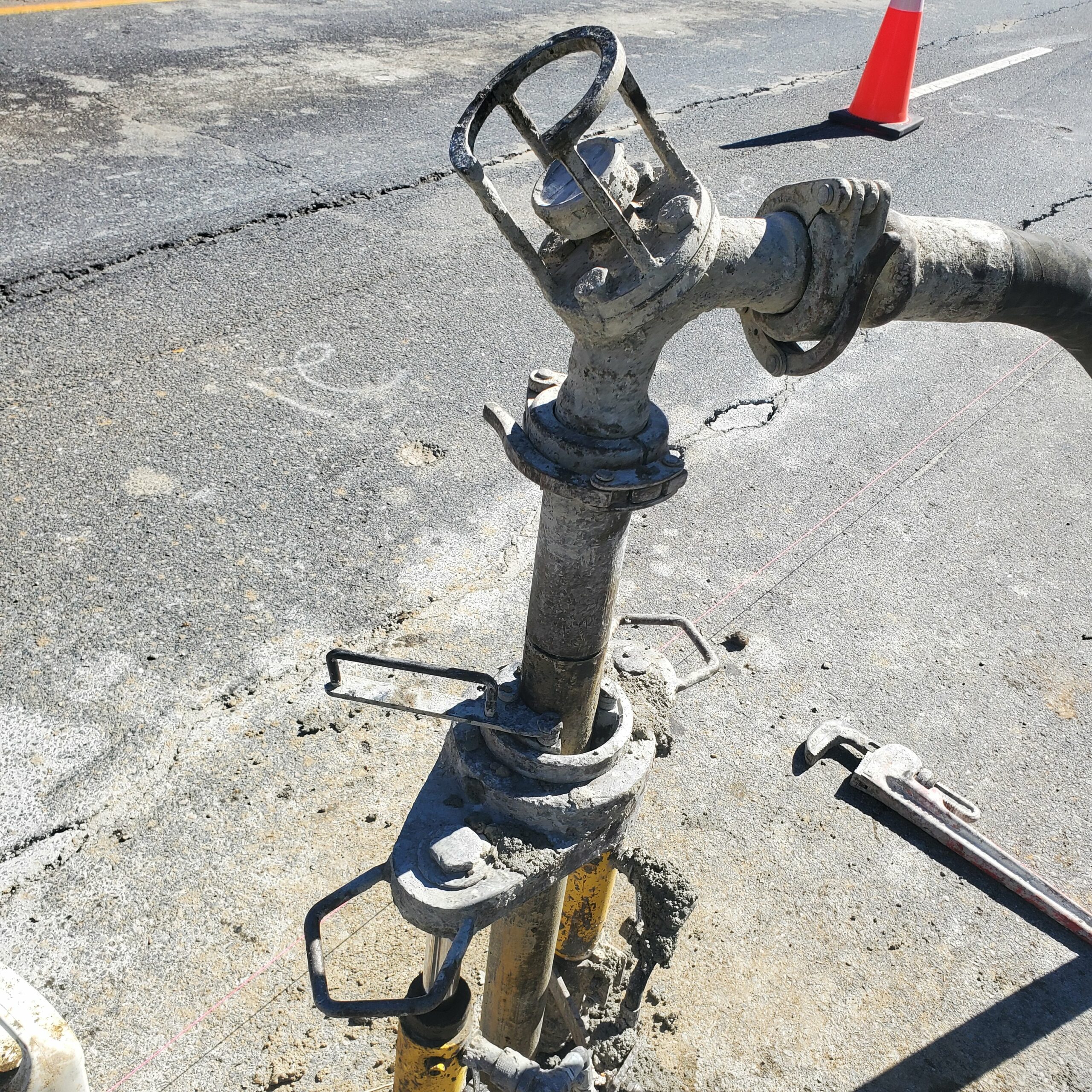
The Salem Limestone's massive-bedded, infrequent fracture character creates singular master conduits that channel groundwater through the Mitchell Plain's karst system. These conduits are where dissolution is most active and where treatment must begin. GeoStabilization International injects low-viscosity chemical grouts into limestone fractures and solution channels, sealing the pathways that carry aggressive groundwater through the rock mass before it can enlarge them further.
Indiana's Mitchell Plain presents a specific challenge here: groundwater flow in the shallow karst aquifers is directly and rapidly linked to rainfall events. Treatment that only addresses visible voids without sealing the fracture network feeding them will see those voids reactivate when the next wet season arrives.
Indiana's Mitchell Plain has a distinctive overburden: terra rosa, the clayey residual soil produced by centuries of limestone dissolution. When voids develop in the Salem Limestone below, terra rosa particles migrate downward into the rock cavities — the soil arch weakens, bearing capacity drops, and surface settlement follows. When the water table fluctuates rapidly — rising or falling with seasonal rainfall — the effective stress on the soil arch changes, accelerating the process.
Compaction grouting addresses this overburden condition directly. Stiff grout columns displace and densify the disturbed terra rosa zone, restoring bearing capacity from the bedrock interface upward through the soil column.
The shallow karst aquifers of the Mitchell Plain are directly and rapidly recharged by rainfall — meaning groundwater levels, dissolution rates, and subsidence risk all fluctuate seasonally. Post-treatment monitoring on Indiana corridors needs to track behavior through at least one full wet-dry cycle to confirm that dissolution pathways are sealed and that the treated overburden is stable under the groundwater conditions that drive Mitchell Plain subsidence.
GeoStabilization International installs settlement monitoring systems calibrated to detect the subtle ground movements that precede visible surface damage — providing early warning if seasonal recharge is reactivating untreated zones before damage reaches the pavement.
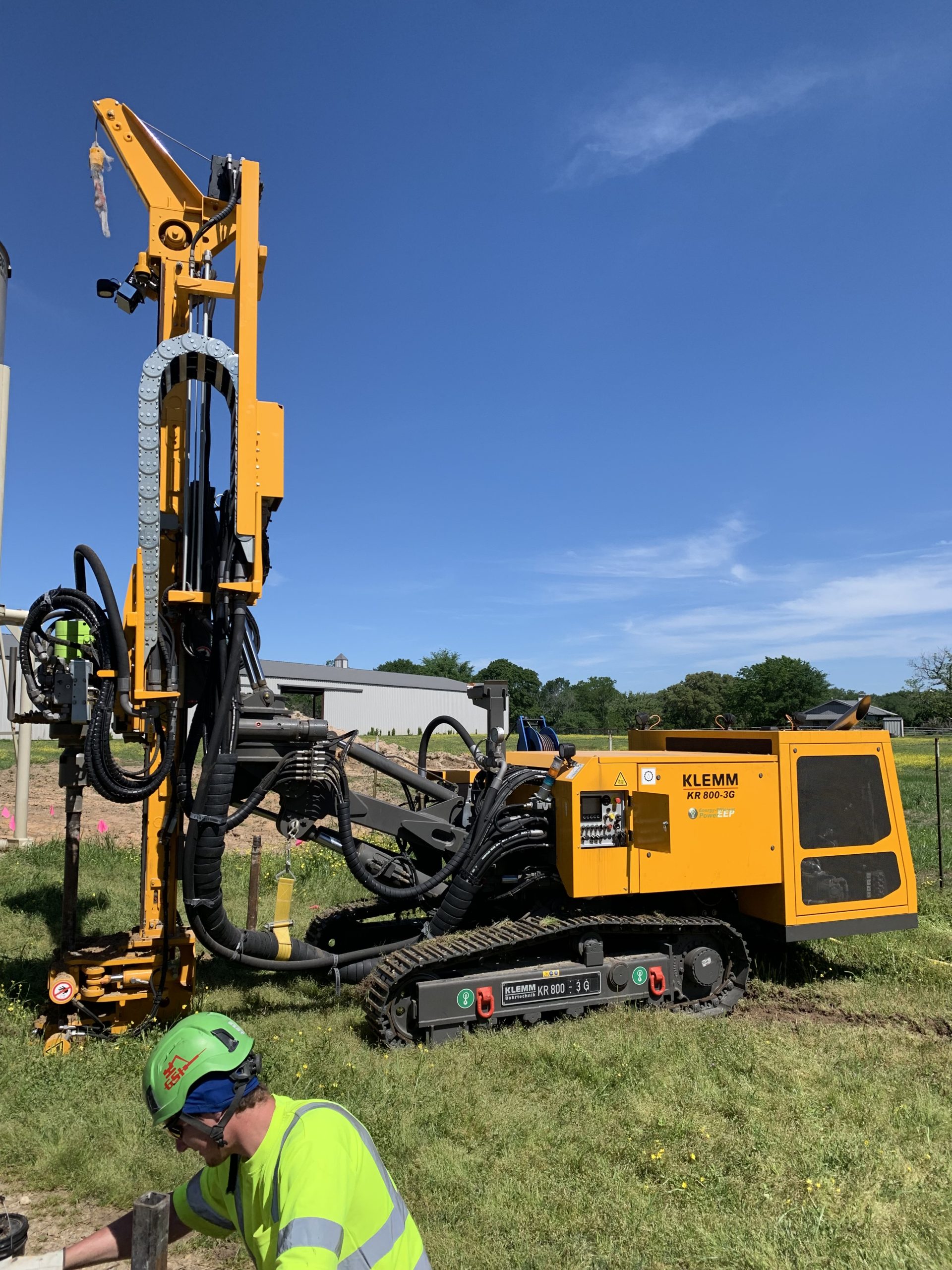
On Indiana's Mitchell Plain, both mechanisms can occur on the same corridor — progressive subsidence where overburden is gradually migrating into fractures, and sudden collapse where a soil arch spanning a larger cavity fails. Treating one without correctly diagnosing the other produces incomplete results. GeoStabilization International's karst specialists design programs matched to the actual mechanism at your site:
Progressive settlement in Indiana's Mitchell Plain limestone today becomes sinkhole collapse tomorrow. GeoStabilization International's karst specialists design treatment programs built for the Salem and Ste. Genevieve formations — addressing the dissolution driving your subsidence before it reaches the surface. Request a subsidence assessment to get started.