



When Hurricane Helene made landfall in late September 2024, record-breaking rainfall caused the Pigeon River to rise more than 30 feet through the Pigeon River Gorge, eroding embankments and swallowing entire sections of I-40's eastbound lanes. A corridor carrying approximately 26,500 vehicles daily was suddenly gone. Even the surviving westbound lanes showed visible tension cracks signaling imminent failure. The closure immediately rippled through the regional economy, forcing traffic onto lengthy detours that added hours to travel times and drove up business costs across Western North Carolina and Eastern Tennessee.
GeoStabilization International (GSI) mobilized within days of the hurricane, partnering with Wright Brothers Construction and Access Limited to launch an emergency response across 10 damaged sites. On the Tennessee side, GSI submitted stabilization designs within 48 hours of the storm and had crews on the ground by October 6, drawing on locally warehoused materials to avoid supply chain delays caused by the storm's infrastructure damage.
The Pigeon River Gorge presented extreme conditions: steep slopes, narrow work windows, and strict U.S. Forest Service regulations within national forest boundaries. Subsurface conditions varied across sites—Pigeon Siltstone, Roaring Fork Sandstone, and Longarm Quartzite—with voids, unstable benches, and tension cracks complicating every lift. Active culverts during storm events and loose shot rock collapsing beneath the road platform created constant safety hazards that required continuous field management.
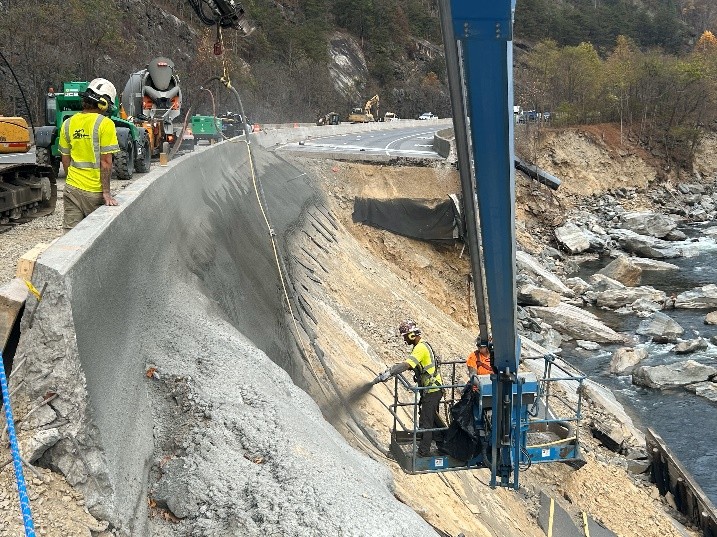
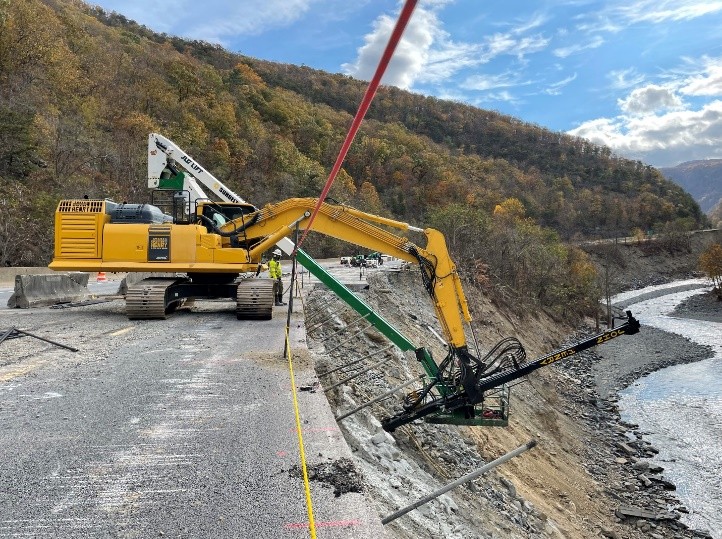
GSI's primary repair technique was soil nailing: drilling threaded steel bars into roadway embankments until reaching bedrock, filling with grout for bonding, attaching steel reinforcement plates, and applying fiber-reinforced shotcrete in 4-inch layers at 4,000 psi. In select locations, reinforced pinned mesh using Tecco G65/3mm provided additional surface stability. Across both states, crews installed 90,000 square feet of soil nail walls in under 130 days, with a record single day of drilling reaching 3,200 linear feet.
Slope inclinometers and automated total station systems monitored ground movement continuously, enabling engineers to adjust nail configurations and reinforcement strategies the moment displacement thresholds were exceeded. Rope-access-trained technicians from Access Limited worked alongside GSI crews using long-reach equipment to safely execute work in otherwise inaccessible locations.
A partial reopening occurred in March 2025, restoring one lane of traffic in each direction across a 12-mile stretch of the gorge. The I-40 response following Hurricane Helene stands as one of the most complex emergency geotechnical mobilizations in the region's history—a testament to the value of design-build emergency preparedness, integrated field execution, and deep geotechnical expertise in protecting critical transportation infrastructure.