Wyoming's Pierre Shale, Niobrara Formation, and Cody Shale deposits contain high-plasticity montmorillonite clays that generate swell pressures exceeding 5,000 pounds per square foot when they absorb moisture. These formations underlie highways, commercial development, and infrastructure corridors across Cheyenne, Casper, and Gillette—where seasonal precipitation and snowmelt cycles drive repeated swell-shrink movements that crack pavements, displace retaining walls, buckle bridge approach slabs, and rupture buried utilities.
WYDOT estimates that expansive soil damage accounts for a significant portion of annual highway maintenance costs across southeastern Wyoming. The damage is progressive—each moisture cycle widens cracks, loosens base course, and reduces pavement life. Maintenance patching treats the surface while the swell cycle continues uninterrupted beneath.
Chemical stabilization permanently modifies the clay mineralogy causing expansion. Hydrated lime reacts with montmorillonite clay minerals through cation exchange and pozzolanic reactions—converting swelling minerals into non-expansive calcium silicate compounds. The swell potential drops by 70–90% permanently after treatment. GSI engineers specify lime dosage, treatment depth, and application methods based on site-specific swell testing.
Where structures have already been damaged by swell cycles, helical piers transfer foundation loads through the active zone to stable bearing strata below. The piers isolate the structure from soil movement—allowing the expansive clay to continue its seasonal cycle without transmitting forces to the foundation above.
Moisture is the trigger for every expansive soil event. GSI designs drainage systems that intercept surface water and reduce subgrade moisture fluctuation—reducing the amplitude of swell-shrink cycles even in untreated soils. Combined with chemical stabilization, drainage management provides a layered defense.
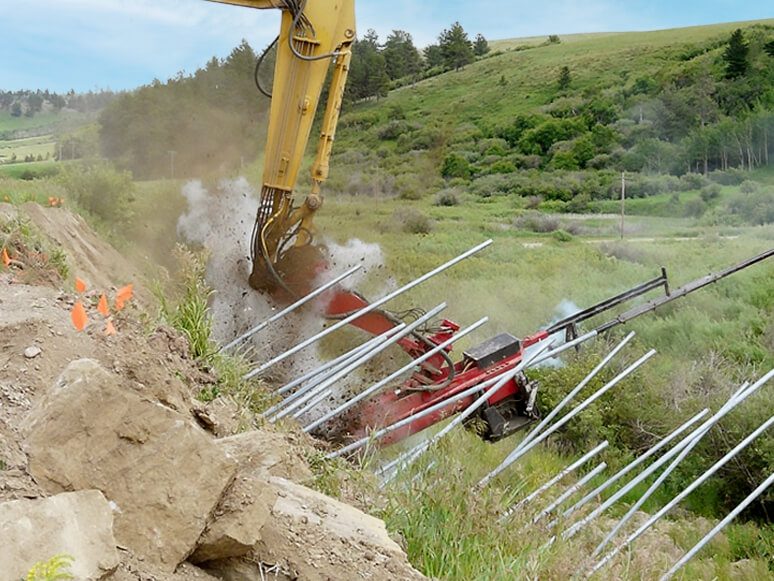
Traditional maintenance treats the symptoms of expansive soil damage while leaving the underlying swell mechanism intact. GSI's chemical stabilization targets the root cause:
Every swell cycle compounds the damage. GSI's chemical treatment permanently modifies the clay mineralogy driving your Wyoming infrastructure problems.