
New Mexico's terrain concentrates some of the most challenging rockfall conditions in the Southwest. Along I-25 at Raton Pass, shale-interbedded rock cuts have required active stabilization work for decades. The NM-68 corridor through the Rio Grande Gorge runs beneath basalt canyon walls carved by millions of years of rift tectonics and erosion — walls that shed rock onto the highway below. US-64 near Taos and NM-152 through the Black Range present similar high-angle slope conditions where fractured rock and seasonal freeze-thaw cycles keep hazards active year-round.
GeoStabilization International deploys rock bolts, anchored mesh systems, attenuator barriers, and scaling operations across New Mexico's most active corridors — with in-house geotechnical engineers who design every solution and field crews who install it under a single NMDOT-ready contract.
New Mexico's geology doesn't produce uniform rockfall risk. The volcanic basalt walls of the Rio Grande Gorge behave differently than the sedimentary formations at Raton Pass or the fractured metamorphic and igneous rock of the Black Range. Each setting requires site-specific characterization — rock mass structure, joint orientation, block size, slope geometry, and runout distance — before a protection system can be properly designed. GeoStabilization International's engineers and geologists collect field data directly at your site before any design decision is made. That means trajectory modeling grounded in actual rock conditions, not catalog assumptions from unrelated formations.
Many of New Mexico's highest-risk rockfall corridors are also the hardest to reach. Canyon walls above NM-68, vertical cuts along I-25, and remote Black Range slopes all present access challenges that eliminate conventional equipment. GeoStabilization International's SPIDER excavators walk directly onto slopes up to 60 degrees — eliminating the need for access road construction and reducing project timelines significantly. Our rope access technicians, certified by both SPRAT and IRATA, perform scaling and installation on vertical rock faces where no equipment can follow.
NMDOT and New Mexico's infrastructure operators benefit from GeoStabilization International's integrated delivery model. The engineers who analyzed your slope's failure modes and modeled rockfall trajectories are connected directly to the crews installing the protection system. When field conditions reveal joint sets or block geometries that change the design — a routine occurrence in New Mexico's complex rock formations — our team responds immediately. No redesign queue. No schedule disruption waiting on a separate contractor.
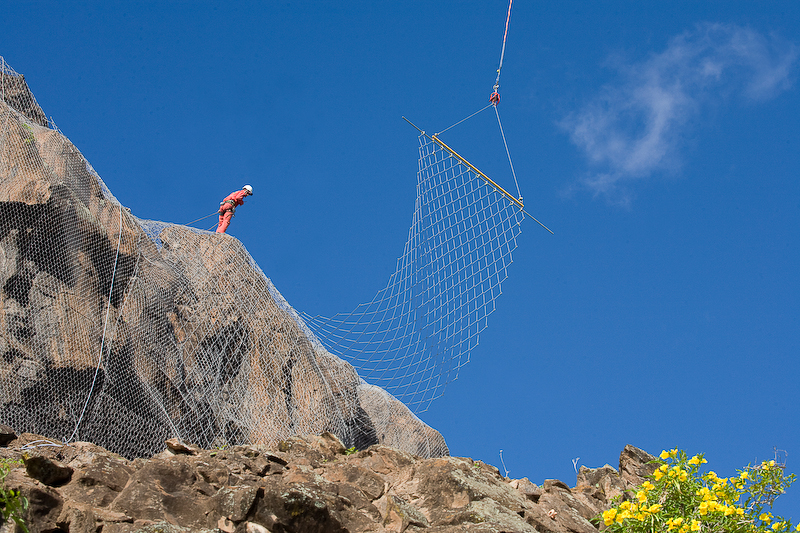
Vertical canyon walls, zero-shoulder highway cuts, and slopes reachable only by rope — these are the conditions GeoStabilization International is built for. Our SPIDER excavators walk onto slopes that tracked equipment can't access. Our SPRAT- and IRATA-certified rope access technicians have earned the Association of Geohazard Professionals' Safety Recognition as a best-in-class program every year since 2018. When the terrain is what makes a project difficult, that's exactly where our capabilities matter most.
Fractured rock above active highway corridors doesn't stabilize on its own — freeze-thaw cycles, seismic activity, and seasonal moisture keep the hazard moving. GeoStabilization International's engineers are ready to assess your site, model the risk, and deliver an engineered solution built for New Mexico's terrain. Request a rockfall assessment to get started.