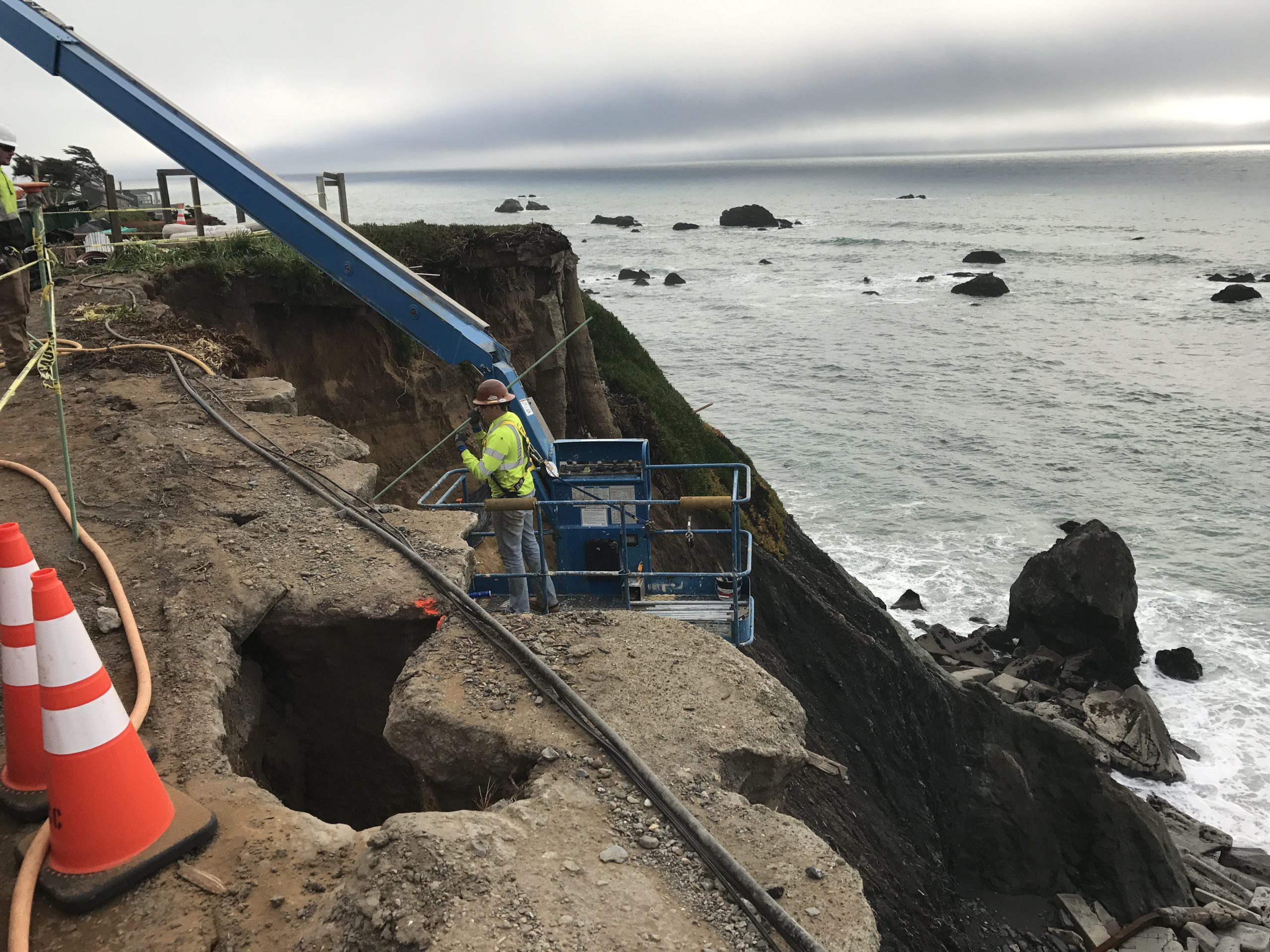
Hawaii's volcanic sea cliffs are among the most geologically active and structurally complex in the world — and several of the state's most critical highway corridors run directly beneath them. On Kamehameha Highway in Hauula, HDOT identified the corridor as the number one erosion hot spot affecting a roadway in the state, with emergency repairs costing $600,000 just for 1,500 feet of affected highway after the road collapsed in 2020. Honoapiilani Highway on Maui was ranked second. Along the Pali Highway in Oahu, the tunnel portals sit beneath slopes containing large, loose boulders of massive basalt that are precariously perched above a roadway carrying up to 60,000 vehicles per day.
The failure mechanism driving Hawaii's sea cliff hazards is consistent: thin to medium bedded basalt flows interbedded with loose clinker and scoria layers that erode at dramatically different rates. As the soft clinker weathers away beneath harder basalt, overhanging cantilevers form — and the combination of intense rainfall, groundwater infiltration, and seismic loading eventually triggers rockfall or block collapse onto the corridor below.
GeoStabilization International deploys rope access inspection, bluff anchoring, rock bolts, and rockfall barrier systems across Hawaii's highest-priority sea cliff corridors — with in-house geotechnical engineers who design every solution and field crews who execute it under a single HDOT-ready contract.
Hawaii's sea cliffs present stabilization conditions that vary significantly between corridors and islands. On Windward Oahu's Pali Highway, the Koolau Range cliffs consist of weathered volcanic rock exploited by cooling joints and vertical fractures — conditions where differential weathering between massive basalt and interbedded weak layers continues to create rockfall source areas above an active road corridor. Along Kamehameha Highway's coastal section, wave undercutting of the cliff base combines with groundwater-driven slope instability to produce both coastal erosion and slope failure events that reach the roadway surface. On the Big Island's Hamakua Coast, deeply weathered volcanic ash deposits overlying lava flows exhibit thixotropic behavior — converting from stable solids to mobile fluids under load or slope steepening — producing episodic cliff failures that can remove 30 to 100 feet of cliff face in a single event. Each setting requires site-specific investigation and a protection approach matched to the actual failure mechanism — not a standard system applied across different geological conditions.
Our engineering team assesses each site's geology, hydrology, fracture patterns, and failure mechanics before any design decision is made. For Hawaii's volcanic rock corridors, that means field-collected data on clinker layer geometry, overhanging block dimensions, groundwater behavior, and wave exposure — information that shapes rope access inspection protocols, bolt patterns, mesh coverage, and barrier sizing for your specific corridor.
When a sea cliff event closes a Hawaiian highway, GeoStabilization International maintains 24-hour emergency mobilization capability with pre-staged equipment and on-call crews. Our team activates an integrated response — engineering assessment, solution design, and construction execution under one contract — compressing the timeline from emergency call to active stabilization that traditional procurement cannot match.
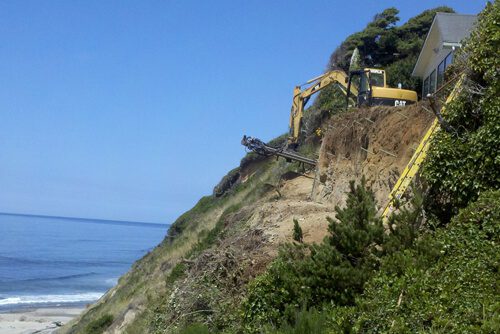
Hawaii's infrastructure operators face a choice: hire a general contractor who subcontracts the engineering and rents equipment, or hire a firm that owns the technology, employs the engineers, and warranties the performance. GeoStabilization International's in-house engineering team and purpose-built field capabilities deliver sea cliff solutions that compress timelines and eliminate the coordination gaps that inflate costs on traditional procurement.
Basalt that stood for thousands of years can fail suddenly when the weak layer beneath it erodes away. GeoStabilization International's engineers are ready to assess your corridor, characterize the failure risk, and deliver a stabilization system built for Hawaii's volcanic geology. Request a bluff assessment to get started.