
Following the February 2020 rockfall event above Monongahela Boulevard in Morgantown, West Virginia, the immediate priority was to stabilize the slope and eliminate the risk of additional rockfall impacting the roadway and West Virginia University’s Personal Rapid Transit (PRT) system below. The slide had dislodged large sandstone blocks and left fractured rock perched along the steep hillside, posing a significant safety hazard to motorists, pedestrians, and university infrastructure.
West Virginia University, in coordination with the West Virginia Department of Highways, engaged Potesta & Associates and GeoStabilization International (GSI) to evaluate the slope and develop an emergency mitigation strategy. Initial site investigations focused on identifying unstable rock masses, assessing the geologic conditions of the sandstone formation, and determining how remaining blocks could be stabilized or removed safely.
Because of the steep terrain and unstable conditions, conventional construction equipment could not safely access the slope. Instead, GeoStabilization deployed its Rockfall Remediation Technicians (RRTs), who used rope-access techniques to scale the slope and manually remove loose material that could trigger additional rockfall during construction activities. This controlled scaling process was critical to establishing safe working conditions for subsequent stabilization work.
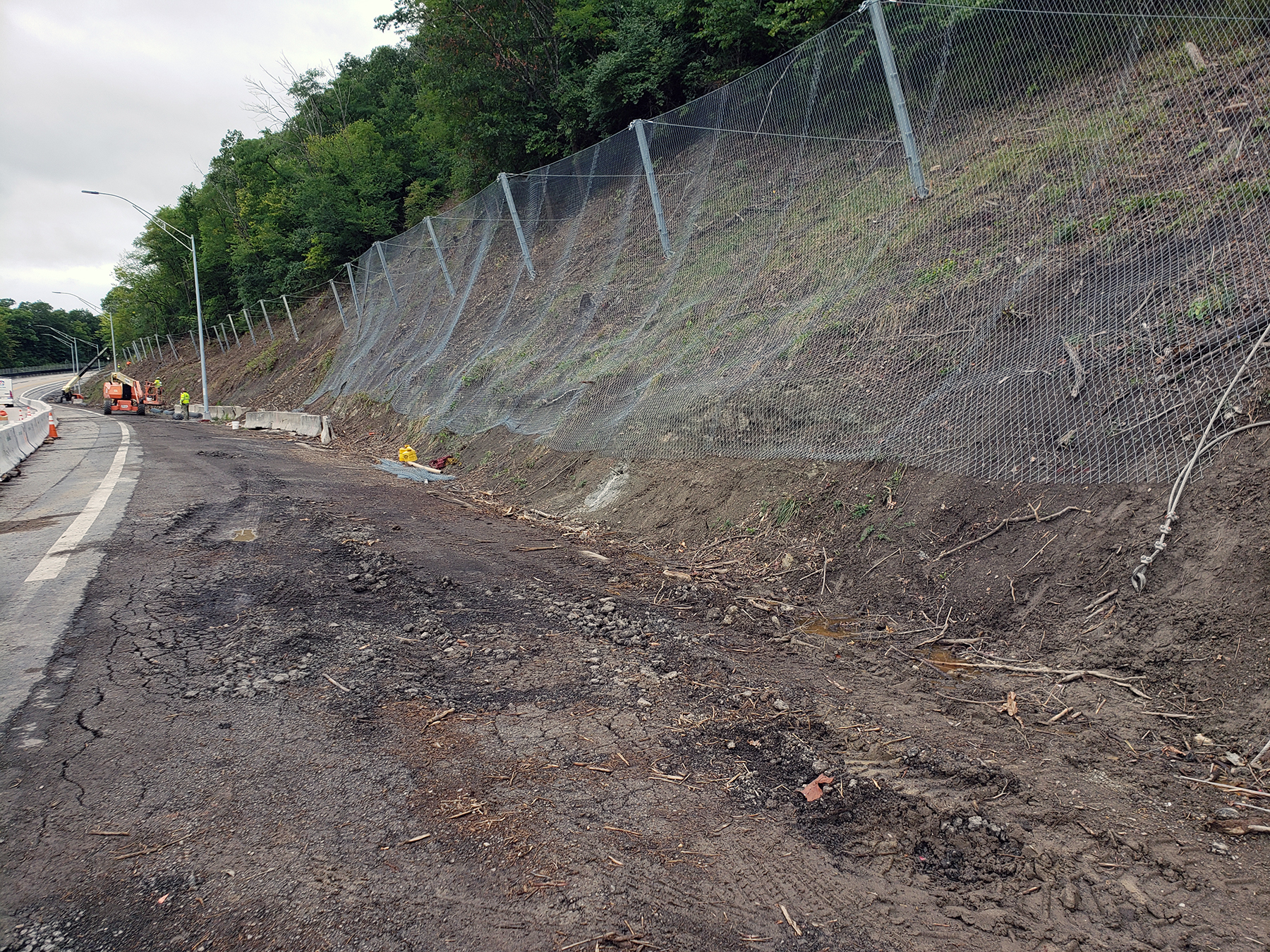
To protect workers and the public during construction, the project team installed a temporary rockfall catchment fence on a mid-slope bench. This barrier acted as a protective system that allowed crews to safely dislodge unstable rock fragments while ensuring that falling debris would be captured before reaching the roadway or PRT tracks below.
During this phase, crews also removed a large sandstone block located midway up the slope that posed a long-term stability risk. The removal was carried out in a controlled manner to prevent damage to nearby infrastructure and to reduce the potential for future rockfall events originating from that section of the slope.
These early mitigation efforts were essential to both immediate hazard reduction and safe construction sequencing, allowing stabilization measures to proceed without exposing workers or the public to additional danger.
After loose material was removed, GeoStabilization began installing rock bolts to secure the remaining sandstone blocks to the stable portions of the slope. Technicians drilled anchor holes into the large sandstone formations and installed high-capacity rock bolts tied back to competent rock behind the slope crest. These anchors effectively fastened the unstable rock masses in place, preventing further movement.
200406WV01_WVU Rockfall_Case St…
Due to the steep terrain and limited access, the drilling operations required specialized equipment. Modified, limited-access drilling rigs were deployed to operate on near-vertical surfaces while technicians worked from rope systems and anchored platforms.
200406WV01_WVU Rockfall_Case St…
This anchoring system provided the structural backbone of the stabilization effort, ensuring that the largest and most hazardous rock blocks were securely integrated into the slope.
With the rock masses stabilized, the next phase focused on protecting the exposed rock surfaces from environmental degradation. Crews applied wet-mix, fiber-reinforced shotcrete above, on, and below the sandstone blocks. This sprayed concrete layer served several critical functions:
Encapsulating fractured rock surfaces
Providing additional structural support
Protecting weaker layers beneath the sandstone overhangs
Preventing water infiltration into joints and fractures
Water intrusion was identified as a key factor contributing to weathering and rock detachment in the slope. By sealing the exposed rock layers with reinforced shotcrete, the team significantly reduced the likelihood of freeze-thaw damage and future rockfall events.
To further enhance long-term slope safety, the project included the installation of a hybrid rockfall attenuator near the base of the slope. This system is designed to intercept and dissipate the energy of falling rocks before they reach the roadway or transit infrastructure below.
Combined with the temporary catchment barrier installed earlier in the project—which remained in place after construction—the attenuator provided an additional layer of protection against future rockfall incidents originating from the lower portions of the slope.
One of the project’s most significant challenges was maintaining safety and minimizing disruption along Monongahela Boulevard, a major transportation corridor connecting West Virginia University’s two campuses. Construction sequencing was carefully planned to limit traffic interruptions while allowing crews to work efficiently on the slope above.
By utilizing rope-access methods and specialized equipment rather than constructing temporary access roads, GeoStabilization was able to perform complex slope stabilization work in a constrained environment while keeping the roadway operational.
The completed rockfall remediation restored safe conditions along Monongahela Boulevard and protected critical campus infrastructure, including the PRT transit system and heavily traveled roadways. Through a combination of slope scaling, rock anchoring, shotcrete armoring, and rockfall protection systems, the project delivered both immediate hazard mitigation and long-term slope stability.
The collaboration between West Virginia University, the West Virginia Department of Highways, Potesta & Associates, and GeoStabilization ensured a rapid response to a dangerous geologic event while implementing durable engineering solutions suited for the site’s challenging terrain.