Palisades diabase sill, New Jersey Highlands gneiss, and Delaware Water Gap quartzite create rockfall hazards along the state's most constrained highway corridors. Along corridors like I-80 through the Delaware Water Gap, I-78 through the Watchung Mountains, Route 23 along the Palisades, and Route 15 through the Highlands, rockfall events threaten public safety, close critical transportation routes, and cost agencies millions in emergency response and repair.
Freeze-thaw cycling, Nor'easter precipitation, salt-induced weathering of rock cuts, and the extreme traffic density beneath exposed rock faces intensify rockfall risk across New Jersey's highway network. When rockfall strikes, the consequences range from lane closures and traffic disruption to structural damage and catastrophic failure of retaining systems. New Jersey's NJDOT, NJ Transit, Palisades Interstate Park Commission, utility providers, and Port Authority infrastructure need a rockfall contractor that understands these conditions.
When rockfall threatens New Jersey's corridors, the response depends on the geology. Palisades diabase sill, New Jersey Highlands gneiss, and Delaware Water Gap quartzite create rockfall hazards along the state's most constrained highway corridors — and Access Limited selects from a full toolkit of control, containment, and scaling systems to match each site along I-80 through the Delaware Water Gap, I-78 through the Watchung Mountains, Route 23 along the Palisades, and Route 15 through the Highlands.
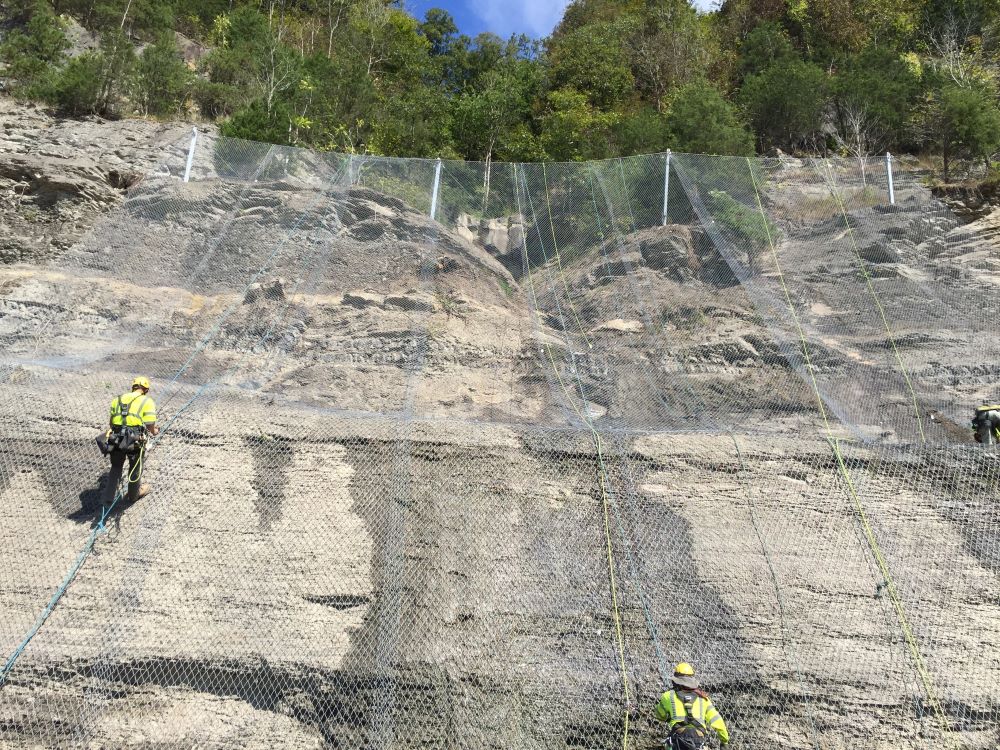
The first line of defense on New Jersey's rockfall faces is engineered mesh. Access Limited installs rockfall mesh for general face containment, pinned mesh for fractured zones requiring positive attachment, wire mesh and rockfall netting for varying energy levels, and cable net mesh for the highest-energy applications. Anchored mesh provides intermediate face support on tall slopes.
Draped mesh systems anchor at the crest and manage the full face height — an approach Access Limited specifies for New Jersey corridors where face geometry prevents economical full-face bolting.
Rock bolting and rock anchors stabilize the rock mass by reinforcing discontinuities before failure occurs. Where rockfall leaves the face, flexible barriers absorb the impact energy at calculated interception points. Catch fences address lower-energy ditch-line rockfall. Attenuation systems provide staged energy reduction on New Jersey's tallest, steepest slopes.
Where New Jersey's terrain produces debris flows — the high-energy mix of rock, soil, and water that overwhelms standard rockfall barriers — Access Limited installs debris flow-specific containment systems engineered for the flow volumes and loading conditions unique to each drainage.
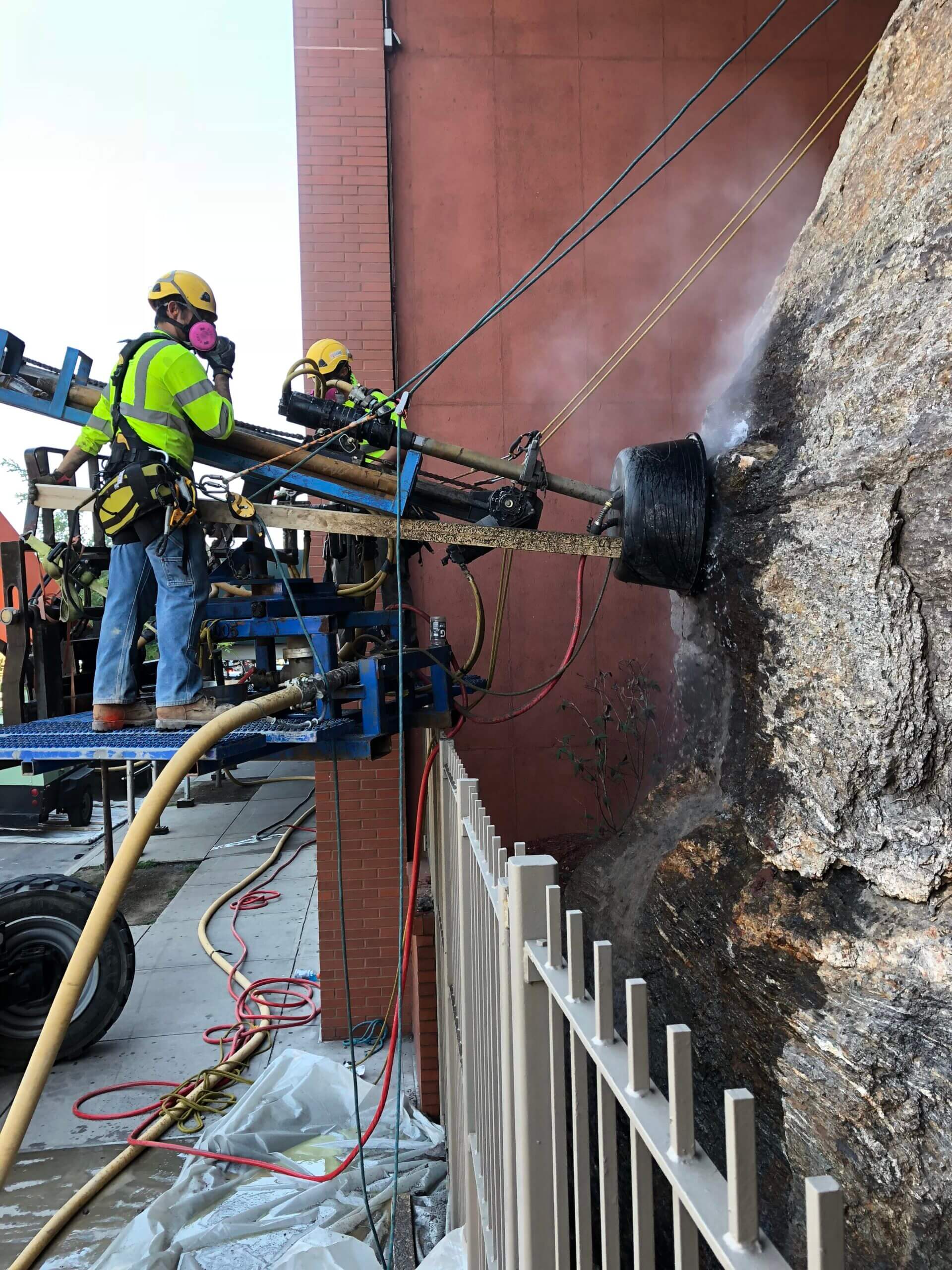
Mechanical, manual, remote, and rope-access scaling operations remove loose rock directly from the face. Controlled blasting addresses large masses. Boulder breaking handles oversized blocks.
Every system Access Limited installs in New Jersey is engineered for the conditions at the specific site. View all geohazard mitigation services available in New Jersey.
See why NJDOT, NJ Transit, Palisades Interstate Park Commission, utility providers, and Port Authority infrastructure trust Access Limited for rockfall mitigation in New Jersey and across the nation.
Access Limited delivers specialized rockfall mitigation and steep slope services across New Jersey. Contact our team to request an assessment.