
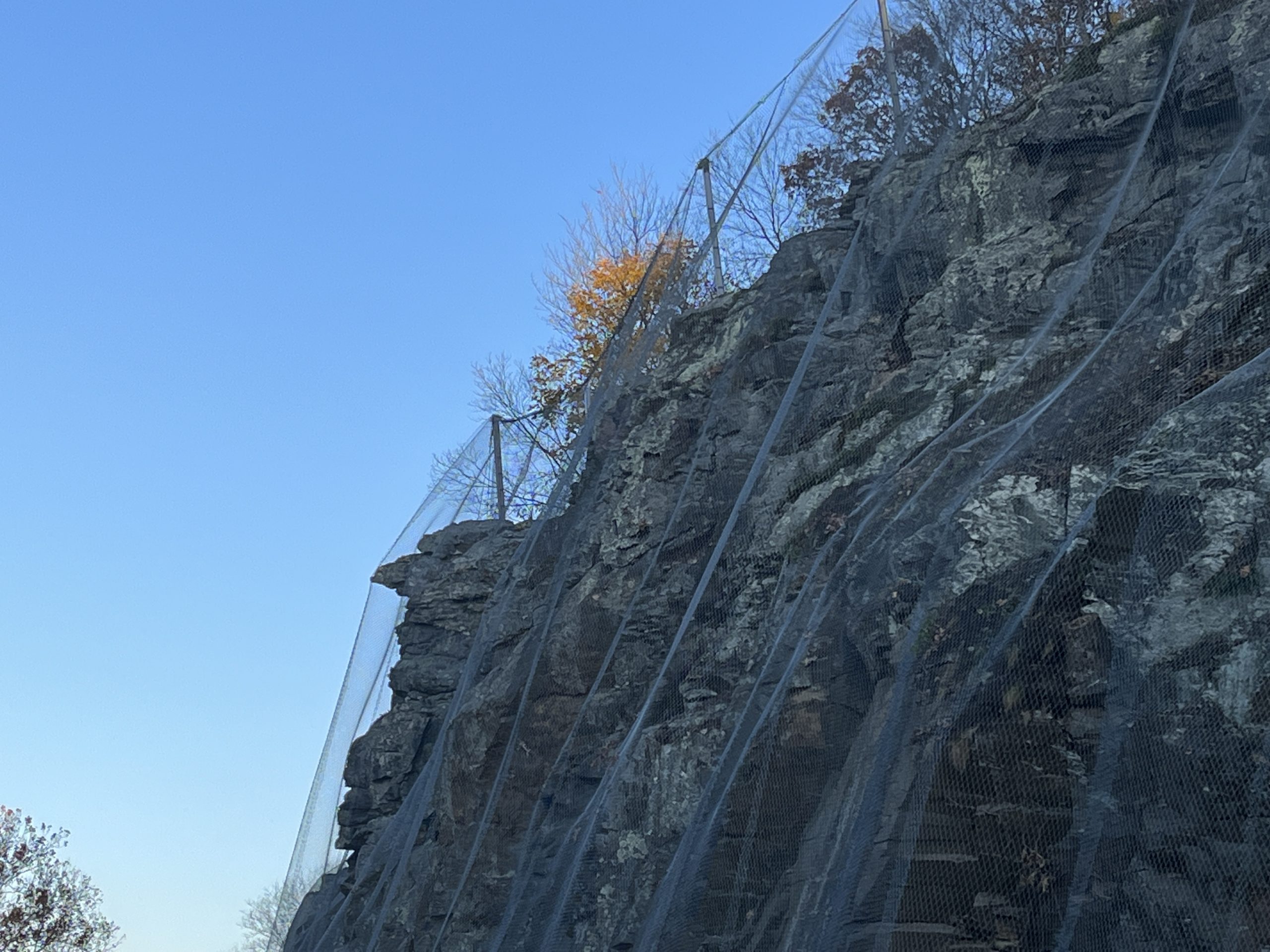
Cumberland Plateau sandstone, Valley and Ridge Province limestone, and Warrior Basin coal measures create rockfall exposure along Alabama's northern highway corridors. Along corridors like I-59 through the Cumberland Plateau, I-65 through the Appalachian foothills, US-431 along Lookout Mountain, and AL-35 through the Bankhead National Forest, rockfall events threaten public safety, close critical transportation routes, and cost agencies millions in emergency response and repair.
Intense subtropical precipitation, mining-related subsidence, and rapid weathering of plateau-edge sandstone escarpments produce rockfall concentrated in north-central Alabama. When rockfall strikes, the consequences range from lane closures and traffic disruption to structural damage and catastrophic failure of retaining systems. Alabama's ALDOT, mining operators, Tennessee Valley Authority, Norfolk Southern rail, and utility providers need a rockfall contractor that understands these conditions.
Access Limited engineers rockfall solutions in Alabama by starting with the geology. Cumberland Plateau sandstone, Valley and Ridge Province limestone, and Warrior Basin coal measures create rockfall exposure along Alabama's northern highway corridors, and corridors like I-59 through the Cumberland Plateau, I-65 through the Appalachian foothills, US-431 along Lookout Mountain, and AL-35 through the Bankhead National Forest demand systems that account for the specific rock mass conditions, not generic assumptions.
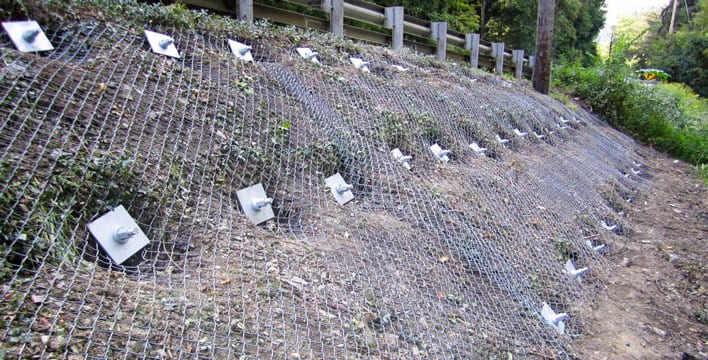
Access Limited's rockfall control systems in Alabama are designed to prevent detachment at the source. Pinned mesh uses a systematic grid of rock bolts to lock fractured blocks against the face — the bolt pattern is engineered to match the discontinuity spacing in the rock mass. Draped mesh is specified when the face is too tall or irregular for full-face pinning — the mesh anchors at the crest and guides material to a designed collection point.
Cable net mesh is the highest-capacity face treatment Access Limited installs, using interlocking steel cables to contain blocks that would puncture standard wire mesh. Anchored mesh combines the drape concept with intermediate face anchors to control deformation on tall slopes. Rockfall mesh and rockfall netting address the lower end of the energy spectrum — persistent, small-block shedding that requires cost-effective long-term coverage.
Flexible rockfall barriers intercept falling rock at calculated positions along the slope. Access Limited sizes every Alabama installation to the trajectory analysis — modeling block launch velocities, bounce heights, and kinetic energy to determine the required barrier rating and placement. Catch fences address moderate rockfall at the ditch line. Attenuation systems stage energy reduction across the slope through successive curtains — reducing the design load on the terminal barrier.
Rock bolting provides passive or active reinforcement across failure surfaces. Fully grouted bolts develop load through rock mass deformation; tensioned rock anchors apply active compressive load across open joints before movement occurs.
Mechanical scaling with Spider Excavators removes loose rock at production rates on slopes exceeding 60 degrees. Manual scaling by rope-access certified technicians addresses faces requiring precision work. Remote scaling and controlled blasting handle large unstable masses. Boulder breaking reduces oversized blocks in the catchment.
Every system Access Limited installs in Alabama is engineered for the conditions at the specific site. View all geohazard mitigation services available in Alabama.
See why ALDOT, mining operators, Tennessee Valley Authority, Norfolk Southern rail, and utility providers trust Access Limited for rockfall mitigation in Alabama and across the nation.
Whether you need rockfall containment, emergency scaling, or a comprehensive slope assessment — Access Limited is Alabama's rockfall mitigation specialist.