New York asset owners and contractors cannot afford guiderail that no longer performs — not with the traffic volumes on the New York State Thruway (I-87 and I-90), the Long Island Expressway, the Taconic State Parkway, and I-84.
A corroded, flattened, or under-height rail stops performing the moment a vehicle hits it — and on New York's salted winter corridors, galvanized coating breaks down even faster. Non-compliant post spacing or missing blockouts can turn a standard run into a liability.
It's the workhorse of roadside safety on those same corridors, and it only works when installed to current MASH standards with the correct deflection distance behind the rail. Whether the site is a distribution center, a corporate campus, or a state highway, RoadGuard delivers in New York.
Road Safety Systems (RSS) and M.L. Ruberton Construction Company deliver roadside safety work across New York.
RSS's roadside-safety specialists and Ruberton's heavy-civil construction teams work together across New York, pairing MASH-compliant installation with the crews, equipment, and DOT familiarity to keep projects moving and inspections passing.
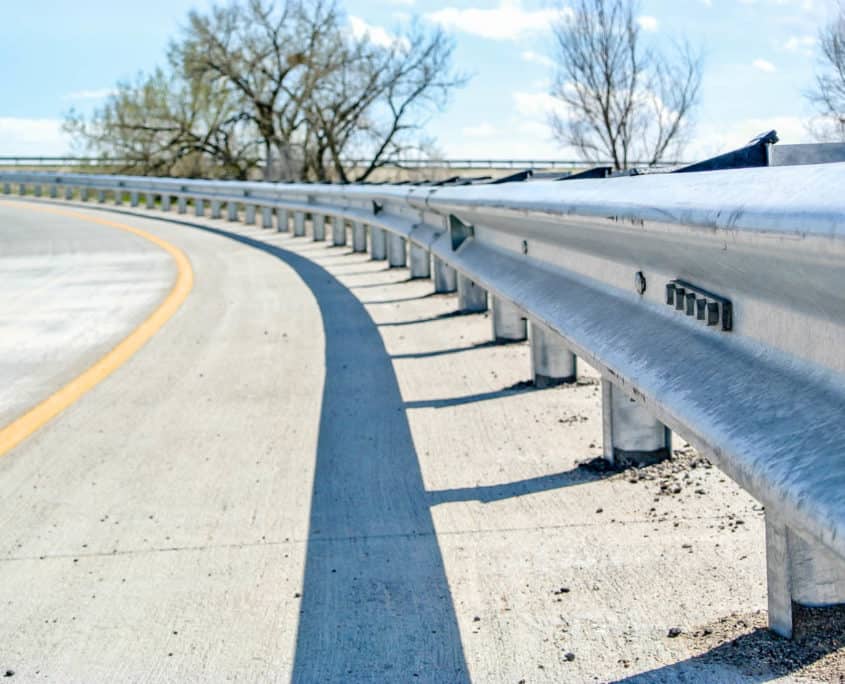
RoadGuard installs W-beam guiderail across New York to MASH and NYSDOT standards, as part of a broader guiderail program covering every corridor from the New York State Thruway (I-87 and I-90) to the Long Island Expressway, the Taconic State Parkway, and I-84. Every system is engineered for the hazard, design speed, and roadside conditions of the site — across New York, from Long Island to the Southern Tier.
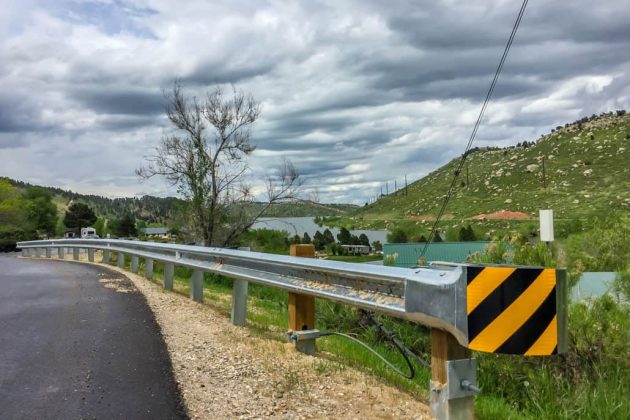
RoadGuard installs galvanized W-beam guiderail to MASH Test Level 3 standards — 12-gauge corrugated rail on steel or wood posts, spaced at an engineered 6 feet 3 inches (or reduced where site conditions call for it), with blockouts that maintain proper rail height and offset.
Every run is only as safe as its ends. RoadGuard installs energy-absorbing MASH-tested end terminals and rigid transitions to bridge rail and concrete barrier, eliminating the spearing hazard of untreated rail ends.
After an impact, RoadGuard replaces damaged panels, posts, and hardware and re-tensions the run — or removes and resets guiderail cleanly when NYSDOT alignments change.
Where site conditions call for something else, RoadGuard installs box beam guiderail for higher-containment applications, high-tension cable barrier for wide medians, and impact attenuators ahead of fixed hazards.
Request a free, no-obligation site visit from your local RoadGuard team. We'll assess conditions and develop a fixed-cost proposal.